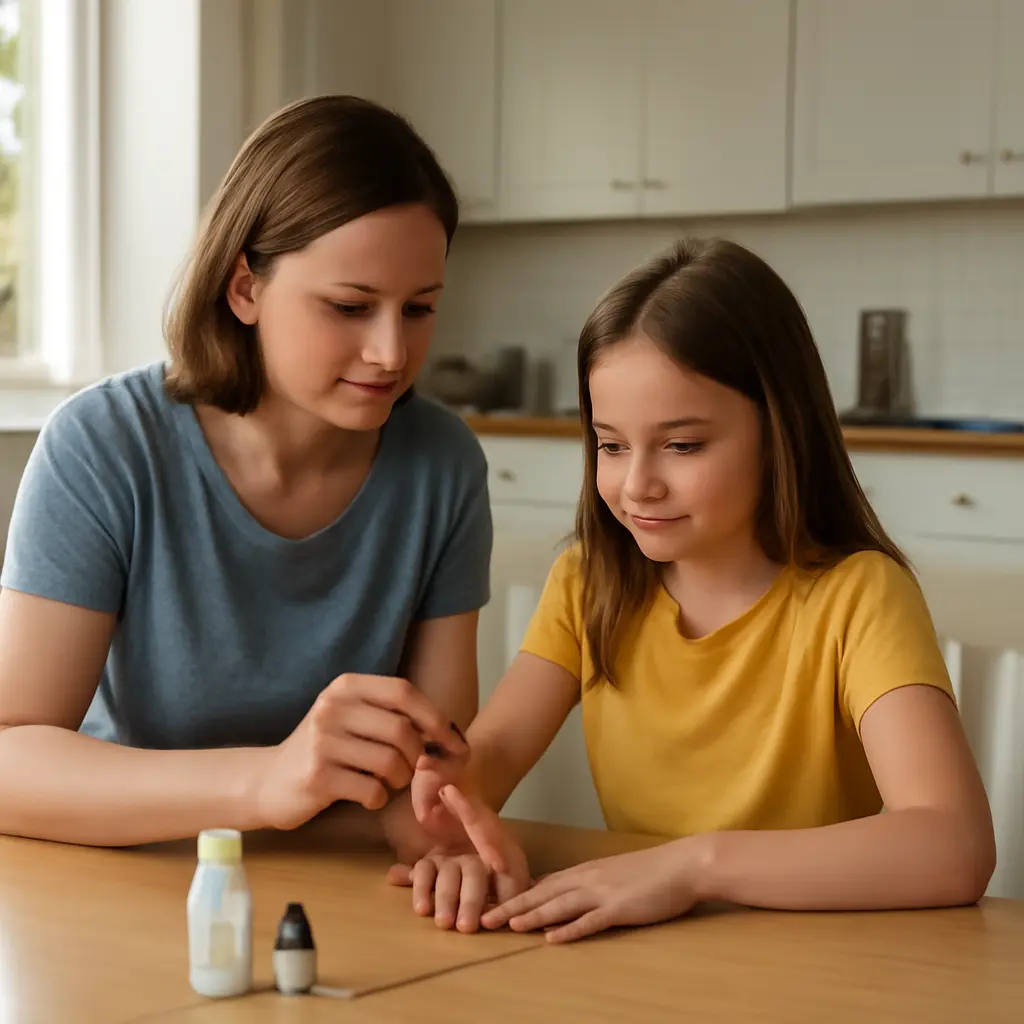
Sparkly nails can be a fun way for children to experiment with color and self-expression, but the safest choice depends on the child’s age, the product, and whether it touches skin or gets into the mouth. Dermatologists generally recommend keeping polish off irritated skin, avoiding cuticle cutting, and choosing age-appropriate products; for very young children, stickers or press-on decorations made for kids can be simpler alternatives. The main concerns are accidental ingestion, irritation or allergy—especially to gel nail ingredients—and infection from shared or poorly cleaned tools.
Nail polish safety: what dermatologists recommend for children
The American Academy of Dermatology (AAD) advises people to avoid nail products that irritate the skin and to stop using a product if redness, itching, swelling, or pain develops. For a child’s manicure, that translates into a few practical precautions: use polish only with adult supervision, apply it in a well-ventilated room, keep it away from the mouth and eyes, and do not paint broken or inflamed skin. A child who is too young to reliably keep hands out of their mouth is generally better suited to non-liquid decorations or simply waiting.
The U.S. Consumer Product Safety Commission (CPSC) notes that nail products can contain chemicals that may be harmful if swallowed, inhaled in significant amounts, or misused. Nail polish remover also warrants care: acetone can irritate skin and eyes and is dangerous if swallowed. Store polish and remover secured and out of children’s reach, even when the bottles appear nearly empty.
Regular polish and “kid-friendly” formulas
Regular nail polish is a film-forming cosmetic applied to the nail plate. Labels such as “non-toxic,” “water-based,” or “3-free” can help parents compare products, but they are not a guarantee that a child cannot have a reaction or that the product is safe to eat. The U.S. Food and Drug Administration (FDA) explains that cosmetics must be safe when used as directed, while cosmetic manufacturers are responsible for substantiating product safety; FDA does not preapprove most cosmetics before they are sold.
Choose a product with clear ingredient and use instructions, and follow the age guidance on its packaging. “Water-based” polish may be easier to remove than conventional polish, but it still should not be swallowed or applied to skin. Avoid products with strong fumes around children with asthma or scent sensitivity, and allow polish to dry fully before the child resumes play.
Gel, acrylic, and artificial nails
Gel polish is cured under a lamp and often contains acrylates, chemicals that can cause allergic contact dermatitis if uncured product contacts the skin. The AAD warns that gel manicures can lead to brittleness, peeling, and cracking, and recommends limiting them. Dermatology literature has also documented allergy to acrylates in nail products, including reactions around the fingers and, through transfer, on the face or eyelids.
For children, it is prudent to skip gel systems, acrylic extensions, and salon-applied artificial nails. These involve stronger products, curing or application steps, and removal processes that may damage the natural nail or expose skin to sensitizing ingredients. A glittery standard polish or a temporary decoration designed for the child’s age is a lower-complexity option.
Sparkly nail choices: glitter, stickers, and press-ons
“Sparkly nails” can mean loose craft glitter, glitter polish, nail stickers, or artificial tips. These are not interchangeable: loose glitter can shed, stickers rely on adhesive, and press-ons can detach and become choking hazards for small children. Keeping decorations limited to the nail and using products specifically intended for nails reduces the chance of eye or skin exposure.
Glitter polish versus craft glitter
Glitter polish suspends decorative particles in a cosmetic base, while craft glitter is not necessarily formulated or tested for use on nails or near eyes. Do not sprinkle craft glitter onto wet polish or use it around a child’s face; particles can get into the eyes or be inhaled. If choosing glitter polish, apply a thin coat with adult help and let it dry completely before the child touches food, toys, or other people.
Stickers and press-on decorations
Nail stickers avoid liquid polish fumes, but their adhesives can still irritate sensitive skin, and small pieces can be swallowed. Press-on nails may loosen during play and pose a choking risk, particularly for toddlers and preschoolers. Use only age-appropriate products, supervise application and wear, remove any loose piece promptly, and avoid applying adhesive to skin or damaged nails. If the child frequently sucks or bites their fingers, skip small detachable decorations.
Allergy, irritation, and nail health
A contact reaction can appear as itching, redness, swelling, blisters, or a rash around the nails; it may also show up on the eyelids or face after a child touches those areas. Irritation is not always an allergy, but the appearance alone may not distinguish them. The AAD recommends stopping the suspected product when a reaction occurs and seeking medical advice if symptoms persist, worsen, or involve significant swelling or pain.
How to reduce exposure
- Have an adult apply the product in a well-ventilated area, away from food and drinks.
- Keep polish, remover, adhesives, and decorations out of reach when not in use.
- Do not paint cuticles, broken skin, or nails that look infected.
- Avoid cutting or aggressively pushing back cuticles; the AAD notes that cuticles help protect the nail root from infection.
- Do not share nail tools, and clean reusable tools after use.
- Remove polish if irritation develops, using the product directions and keeping remover away from the child’s eyes and mouth.
When to seek medical advice
Contact a pediatrician or dermatologist if a rash persists after the product is removed, if the nail becomes painful or swollen, or if there is pus, spreading redness, or a change in the nail’s shape or color. If a child swallows polish, remover, adhesive, or another nail product, contact Poison Control in the United States at 1-800-222-1222 for case-specific guidance; call emergency services for severe symptoms such as trouble breathing, collapse, or seizures. Do not induce vomiting unless a poison specialist or clinician tells you to.
A simple, safer sparkle routine
- Check the child’s age, habits, and the product label. If the child puts fingers in their mouth or cannot sit still for application, choose stickers made for children or wait.
- Use a small amount of nail-specific polish, with an adult applying it in a ventilated space.
- Keep the product on the nail plate, not the surrounding skin, and allow it to dry fully.
- Store all products securely and check the nails and surrounding skin for irritation over the next day or two.
- Remove the decoration if it becomes loose, uncomfortable, or irritating.
A brief, supervised manicure can be a pleasant creative activity, but there is no need to use gel or artificial nails to achieve a sparkly look. Choose simple products, prevent ingestion and skin contact, and treat any persistent reaction as a reason to stop and ask a clinician. For product-specific concerns, consult the label and the FDA’s cosmetic safety information; for an exposure incident, contact Poison Control.
Sources: American Academy of Dermatology, Gel manicures: Tips for healthy nails, https://www.aad.org/public/everyday-care/nail-care-secrets/manicure-pedicure/gel-manicures; American Academy of Dermatology, How to care for your nails, https://www.aad.org/public/everyday-care/nail-care-secrets/basics/care; U.S. Food and Drug Administration, Cosmetics: How to use cosmetics safely, https://www.fda.gov/consumers/consumer-updates/cosmetics-how-use-them-safely; U.S. Food and Drug Administration, FDA Authority Over Cosmetics: How Cosmetics Are Not FDA-Approved, but Are FDA-Regulated, https://www.fda.gov/cosmetics/cosmetics-laws-regulations/fda-authority-over-cosmetics-how-cosmetics-are-not-fda-approved-are-fda-regulated; U.S. Consumer Product Safety Commission, Nail Polish, https://www.cpsc.gov/Newsroom/News-Releases/1994/Nail-Polish; National Capital Poison Center, Nail polish and remover, https://www.poison.org/articles/nail-polish-and-remover-184; U.S. Department of Health and Human Services, Poison Help, https://poisonhelp.hrsa.gov/.