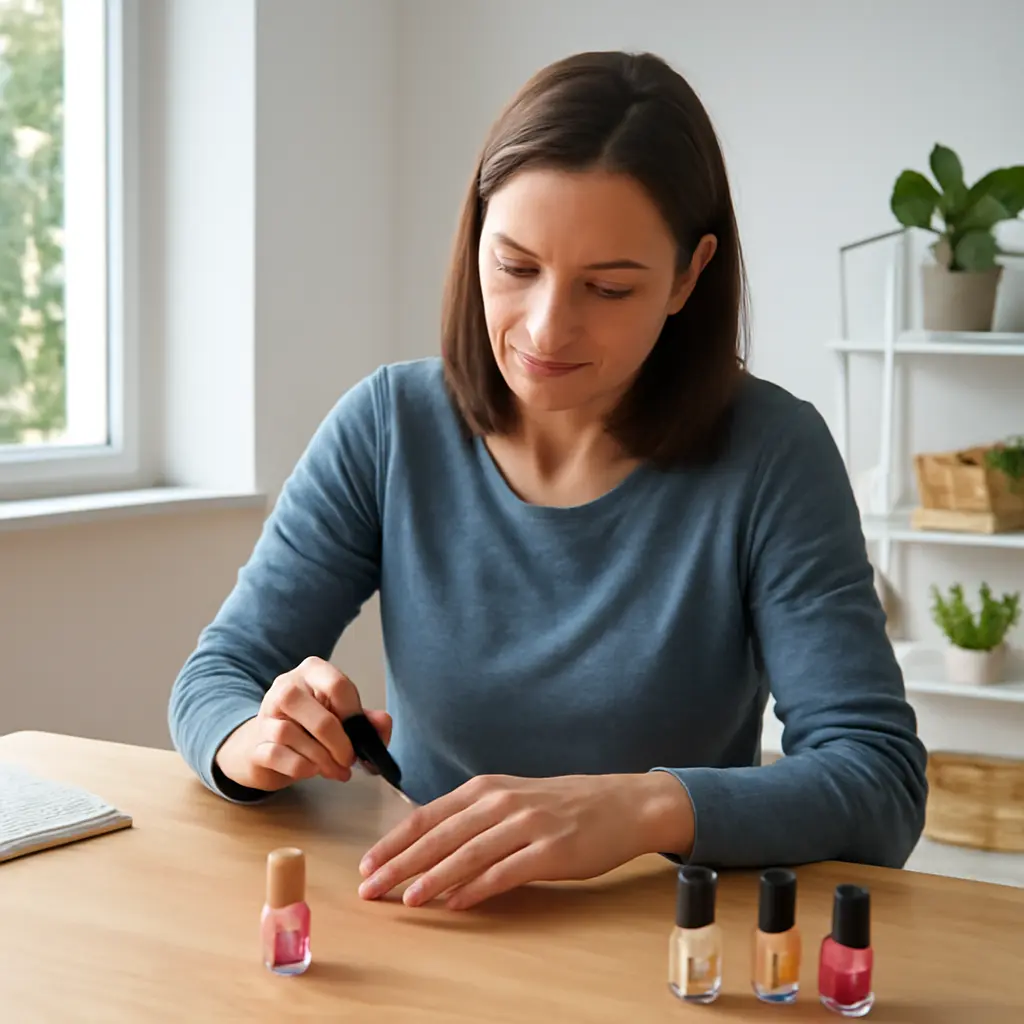
Water-based nail polish is polish in which water serves as a primary carrier for the color and film-forming ingredients. The marketing often emphasizes less odor or fewer familiar solvents, but “water-based” does not mean chemical-free, automatically safer, or equally durable across every product. The useful distinction is between a formula’s carrier, its full ingredient list, and its tested performance: water can reduce reliance on volatile organic solvents, while preservatives, pigments, and film-forming polymers still shape safety, drying, wear, and removal. Understanding those trade-offs helps shoppers assess claims without assuming every conventional polish is harmful or every water-based alternative is harmless.
What “water-based” means in nail polish formulas
A water-based formula uses water as a major liquid carrier, generally dispersing or carrying ingredients that form a colored film as the polish dries. It is a product description, not a universal regulatory grade or a guarantee that water is the only solvent. The U.S. Food and Drug Administration (FDA) explains that cosmetics may contain many kinds of ingredients and that cosmetic ingredient labeling is subject to specific requirements; consumers should therefore read the complete label rather than rely on a front-of-package phrase.
The main comparison is with many conventional solvent-based nail polishes, which commonly use volatile liquids such as ethyl acetate or butyl acetate to keep resins and other ingredients workable. As the coating dries, the carrier evaporates and a film remains. Water-based products can instead rely on polymer dispersions and other formulation aids. Exact compositions differ by brand, and a “water-based” label alone does not establish the percentage of water, the absence of all volatile ingredients, or a particular health outcome.
Water as carrier, not a safety certificate
In formulation, a carrier helps distribute ingredients and makes a product applicable. Water’s presence may reduce the need for some conventional organic solvents, but the finished product still contains substances that create color, adhesion, flexibility, and shelf stability. Depending on the formula, these can include film-forming polymers, pigments, plasticizers, thickeners, and preservatives. The FDA notes that cosmetics are not generally approved by the agency before sale, apart from color additives and certain other legal requirements, so “water-based” should not be interpreted as an FDA endorsement or safety certification.
Water-based, low-odor, and “free-from” claims are different
“Water-based” describes a formulation feature; “low odor” describes a sensory impression; and “free-from” claims identify ingredients a manufacturer says it has omitted. These claims are not interchangeable. A product may smell less noticeable but still contain ingredients that can irritate or trigger an allergy, while a product that omits one named solvent may use other ingredients to achieve similar performance. Check the ingredient list and the wording on the package, and ask the manufacturer for clarification when a claim is important to you.
What water-based formulas change—and what they do not
The most meaningful potential difference is the carrier system and, consequently, the product’s evaporation and odor profile. The U.S. Environmental Protection Agency (EPA) defines volatile organic compounds (VOCs) as carbon-containing compounds that evaporate readily under ordinary indoor conditions, while noting that VOCs vary widely in their health effects. A water-based product may reduce some solvent-related emissions compared with a particular solvent-heavy alternative, but neither the water-based label nor a low-odor impression provides enough information to quantify a product’s VOC emissions or overall risk.
Odor and indoor air
Odor can be a practical clue that a product is releasing airborne chemicals, but smell is not a reliable measurement of exposure or hazard. EPA guidance on indoor air quality recommends reducing pollutant sources and using ventilation where appropriate. For nail polish, follow the product directions, avoid prolonged use in poorly ventilated spaces, and close the container promptly. These precautions are sensible for any polish; they do not establish that a particular water-based formula is risk-free or that every conventional formula poses the same level of concern.
Drying, wear, and water resistance
Water-based polish often dries through water evaporation and the formation of a polymer film. That mechanism can make drying feel different from solvent-based polish, and products may vary in how quickly they become touch-dry, how well they resist chipping, and how long they last. Water in the formula does not mean the finished coating will necessarily dissolve in water; the dried film’s performance depends on its polymers, additives, application thickness, and curing conditions. There is no single independent, standardized public dataset establishing that all water-based polishes last a specific number of days, so brand-specific wear claims should be treated as product claims rather than universal facts.
Removal and the “peel-off” category
Some water-based polishes are designed to peel away, while others require a remover or prolonged soaking. Peel-off behavior is a product design choice, not an automatic property of every water-based formula. Pulling off a coating that does not release easily can also remove or roughen layers of the natural nail. Follow the manufacturer’s removal instructions, and stop if the polish resists rather than forcing it off.
Safety depends on exposure, ingredients, and use
A fair safety assessment considers the ingredient, the amount and route of exposure, how often the product is used, and the person’s sensitivity. The American Academy of Dermatology (AAD) identifies nail products as possible causes of allergic contact dermatitis, including reactions around the fingertips or on areas touched by the hands. Reactions can involve ingredients such as acrylates in some nail systems; that does not mean every water-based polish contains them. People with prior reactions should review the specific formula and consult a qualified clinician rather than relying on broad “non-toxic” or “clean” language.
Skin contact and allergy
Allergic contact dermatitis is an immune reaction that can develop after skin contact with a sensitizing ingredient. Keep polish on the nail plate rather than the surrounding skin, avoid using products on irritated or broken skin, and discontinue use if itching, swelling, redness, or blistering develops. The AAD recommends medical evaluation for suspected nail-product allergy because identifying the responsible ingredient may require professional assessment and can help prevent repeat exposure.
Children, pregnancy, and sensitive users
People seeking lower odor or less solvent exposure may prefer to compare water-based options, but the label alone cannot answer whether a product is suitable for a child, someone who is pregnant, or someone with asthma, allergies, or another health condition. Keep polish and removers out of children’s reach, use products only as directed, and consult a healthcare professional for individual medical concerns. The FDA advises consumers to report serious reactions to cosmetics; a product’s marketing language should not replace that step when a significant reaction occurs.
How to evaluate polish marketing claims
The best way to compare products is to separate measurable formula information from promotional language. A credible claim should identify what is being compared and what evidence supports it. “Water-based” can describe the carrier, but claims such as “safer,” “non-toxic,” “chemical-free,” or “better for the environment” need additional context: safer for whom, under what use conditions, and measured against which alternative?
Read the full ingredient list and directions
Use the ingredient declaration to check for substances you personally need to avoid, and read warnings and removal instructions. If a product is sold in a market where ingredient-label rules differ, consult the relevant regulator’s guidance. In the United States, the FDA provides consumer information on cosmetic labeling and advises consumers to contact the manufacturer when they need information that is not clear from the package.
Ask what “better” is being measured against
A comparison is meaningful only when it specifies the outcome: odor, VOC content, drying time, wear, or a particular ingredient’s presence. For example, a brand might accurately state that a formula omits a named solvent without proving that it has lower overall emissions or fewer allergy risks. Look for test methods, product-specific evidence, and clear qualifications rather than relying on a badge or a vague “free-from” list.
Choosing and using water-based nail polish
Water-based polish can be a reasonable option for shoppers who value a different carrier system or prefer a less noticeable odor, provided the product meets their needs for application, wear, and removal. Conventional polish may suit users who prioritize a familiar finish or longer wear. Neither category is universally best; the appropriate choice depends on the specific formula, personal sensitivities, intended use, and willingness to follow safe handling instructions.
- Check the complete ingredient list and the specific claim you care about.
- Apply polish in a ventilated area and keep it away from skin, eyes, and children.
- Follow the product’s drying and removal instructions; do not peel or scrape a coating that is not designed to peel.
- Stop using the product if irritation or an allergic reaction develops, and seek medical advice for persistent or severe symptoms.
- For environmental or indoor-air concerns, look for product-specific emissions or life-cycle evidence rather than assuming water-based automatically means impact-free.
Conclusion: look beyond the water-based label
Water-based nail polish is defined by its carrier system, not by a blanket promise of safety, durability, or environmental benefit. Its odor and drying profile may differ from solvent-based polish, but the rest of the formula still matters—including film-formers, pigments, preservatives, and any ingredients that may irritate or sensitize. Read the label, evaluate claims according to the evidence provided, use polish with ventilation and care, and consult a healthcare professional about allergies or other individual concerns. For further guidance, review consumer information from the FDA, indoor-air resources from the EPA, and nail-product allergy advice from the AAD.
Sources: U.S. Food and Drug Administration, “Cosmetics Labeling Guide,” https://www.fda.gov/cosmetics/cosmetics-labeling-regulations/cosmetics-labeling-guide; U.S. Food and Drug Administration, “Cosmetics: Overview,” https://www.fda.gov/cosmetics/cosmetics-overview; U.S. Environmental Protection Agency, “Volatile Organic Compounds’ Impact on Indoor Air Quality,” https://www.epa.gov/indoor-air-quality-iaq/volatile-organic-compounds-impact-indoor-air-quality; U.S. Environmental Protection Agency, “Care for Your Air: A Guide to Indoor Air Quality,” https://www.epa.gov/indoor-air-quality-iaq/care-your-air-guide-indoor-air-quality; American Academy of Dermatology Association, “Nail Care Products,” https://www.aad.org/public/everyday-care/nail-care-secrets/basics/nail-care-products.