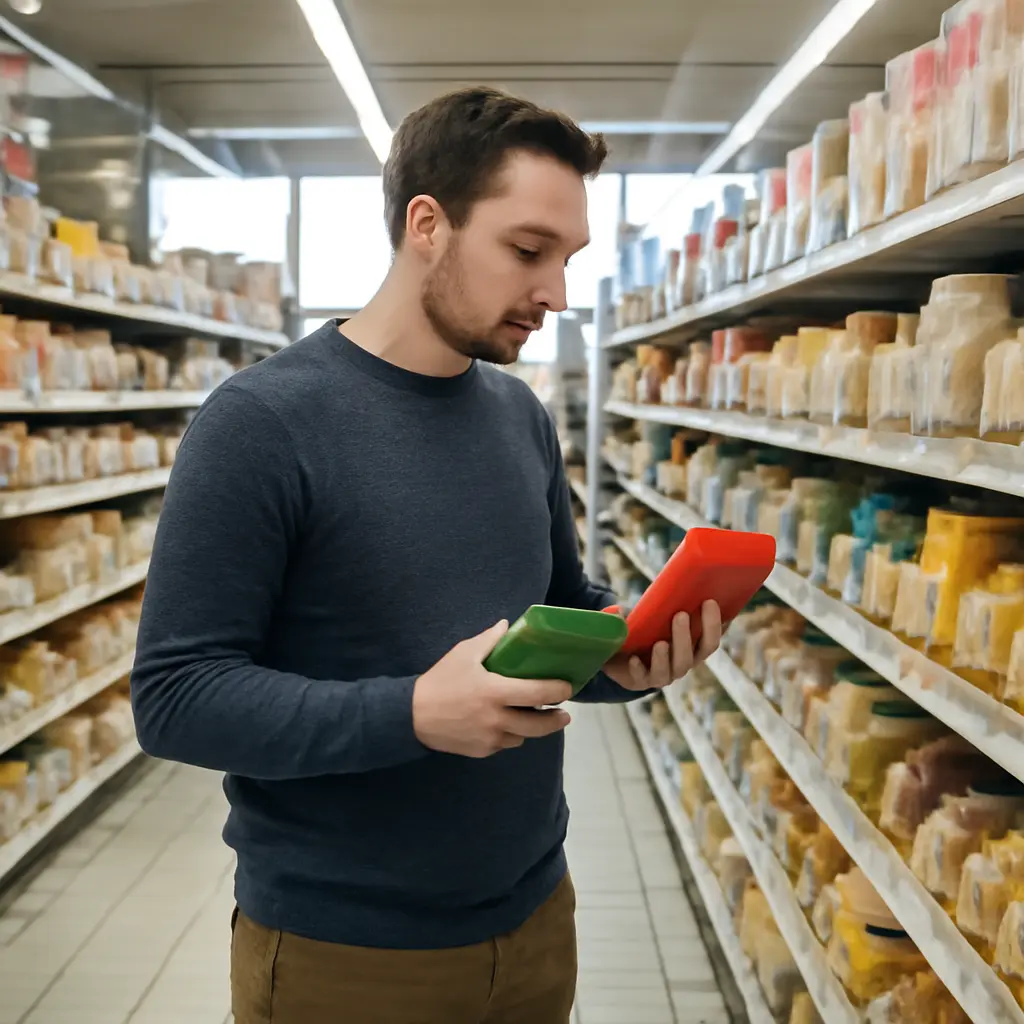
Polish packaging is the information printed on food and drink packs sold in Poland: ingredient lists, allergen warnings, nutrition panels, dates, storage directions and marks that explain how to sort the packaging. You do not need a chemistry degree to read it. Start with the product name and ingredients, check allergens and the nutrition table, then look for storage and date instructions; finally, use the packaging’s material and disposal guidance. These details matter in a country where food labels follow European Union rules and where Poland’s packaging-return system is changing how some bottles and cans are collected.
Polish food labels explain product identity and composition
A food label is the information accompanying a food that helps consumers identify it and understand its composition, quantity, handling and nutritional characteristics. The European Commission explains that Regulation (EU) No 1169/2011 sets the core requirements for food information provided to consumers across the EU, including Poland. This common framework is why many label elements look familiar across European countries, even when the text is in Polish.
For packaged foods, mandatory information generally includes the food’s name, ingredients, highlighted allergens, certain quantity details, durability or use-by information, storage or use instructions where needed, the responsible food-business operator, and a nutrition declaration. Exact requirements vary by product, so not every pack displays every possible detail.
The product name and ingredients
Look first for nazwa żywności (name of the food) and składniki (ingredients). Ingredients are generally listed in descending order by weight as used in manufacture. A product’s familiar brand name may be prominent, but the descriptive food name is what clarifies what is actually inside—for example, whether a drink is juice, nectar or a flavoured beverage.
Ingredient lists can include additives identified by their functional class and name or E-number. An E-number is an EU identification code for an authorised food additive; it is not, by itself, a warning that the additive is unsafe. The European Food Safety Authority evaluates food additives within the EU safety system. If you want to know what an additive does, look for its function—such as colour, preservative or emulsifier—rather than judging it by the code alone.
Allergens and cross-contact warnings
Allergens are ingredients that can trigger allergic reactions in susceptible people. Under EU rules, 14 specified allergen categories must be clearly emphasised when present as ingredients—for example, through bold type, capitals or a contrasting style. Common Polish label terms include mleko (milk), jaja (eggs), orzeszki ziemne (peanuts), soja (soy) and gluten (gluten).
Statements such as może zawierać (“may contain”) are precautionary cross-contact warnings, not a replacement for the ingredient list. If you have a serious allergy, check both parts of the label and contact the manufacturer when the wording is unclear. The European Commission’s rules require allergen information to be available for foods, including non-prepacked foods, though the way it is provided can differ.
Nutrition information and serving size
The nutrition declaration normally gives energy and amounts of fat, saturated fat, carbohydrate, sugars, protein and salt per 100 grams or 100 millilitres. It may also provide values per portion. The per-100-g or per-100-ml figures make it easier to compare similar products; portion figures can help estimate what you consume, but portion sizes are not always the same between brands.
Energy may appear in kilojoules and kilocalories, while sól means salt and cukry means sugars. Salt on the nutrition panel is not necessarily the same as the amount of sodium listed in some countries’ systems. The EU reference intake commonly shown on labels is based on an average adult diet of 8,400 kJ (2,000 kcal), not a personalised recommendation. The European Commission notes that nutrition declarations are standardised under Regulation 1169/2011, with exemptions for some categories of food.
Polish date and storage statements guide safe use
Date marks and storage directions tell you how long a product is expected to retain its quality or remain safe when handled as instructed. The distinction between a quality date and a safety deadline is important: treating them as interchangeable can lead either to unnecessary food waste or to unsafe decisions.
“Best before” and “use by”
Najlepiej spożyć przed means “best before.” It indicates the period during which a food is expected to retain its intended quality when properly stored. After that date, quality—such as taste or texture—may decline, but the date alone does not automatically mean the food is unsafe.
Należy spożyć do means “use by.” It is used for foods that are highly perishable from a microbiological point of view. Follow this deadline and the stated storage conditions; the European Commission advises that food should not be eaten after its use-by date, even if it looks or smells normal. The European Food Safety Authority has also highlighted the difference between date marking for safety and date marking for quality as relevant to reducing food waste without compromising safety.
Storage and preparation instructions
Terms such as przechowywać w lodówce (“keep refrigerated”) and po otwarciu przechowywać w lodówce (“refrigerate after opening”) describe conditions needed to preserve quality or safety. Follow the stated temperature and any instruction to consume the food within a certain period after opening. For products requiring cooking, preparation directions are not merely serving suggestions: they may be essential to make the food safe.
A practical habit is to read the storage instructions before opening a pack and keep the relevant information visible afterward. If a product has been stored contrary to its instructions, its printed date may no longer be a reliable guide.
Polish packaging marks identify materials and disposal routes
Packaging marks help identify what a pack is made from and how it may be collected. They do not all mean the same thing: a material code identifies a material category, while a recycling symbol or disposal instruction may communicate a separate claim. Local collection rules also matter, so a symbol should not be treated as a guarantee that every municipality accepts an item in the same way.
Material codes and familiar symbols
Codes such as PET for a type of plastic, HDPE for high-density polyethylene, ALU for aluminium and PAP for paper-based material can help you recognise packaging components. A pack may combine several materials—for example, a paperboard carton with a plastic cap—so check whether the parts can be separated and whether the label gives sorting instructions.
The familiar “Green Dot” symbol should not be read as proof that a particular pack is recyclable. It indicates participation in a packaging recovery financing scheme in markets where the mark is used. Likewise, a chasing-arrows triangle with a number is generally a resin identification code, not a promise that the item is accepted by every recycling system.
Sorting labels and Polish waste colours
Polish households commonly sort municipal waste into colour-coded streams: blue for paper, yellow for metals and plastics, green for glass, brown for bio-waste and black or grey for residual waste. The Polish Ministry of Climate and Environment describes these as the standard selective collection system, while local authorities provide the detailed rules for their areas.
Before sorting, empty the packaging and separate components when practical. A greasy or food-soiled item may not belong in the same stream as clean material, and composite packaging may require different handling from a single-material container. Follow the instructions on the pack and your municipality’s current guidance rather than assuming that colour or material alone settles the question.
Deposit-return packaging in Poland
Poland began introducing a national deposit-return system on 1 October 2025. The Ministry of Climate and Environment describes covered packaging as including single-use plastic beverage bottles up to 3 litres, metal cans up to 1 litre, and reusable glass bottles up to 1.5 litres; the stated deposit amounts are 0.50 zł for plastic bottles and cans and 1 zł for reusable glass bottles. Check the current official guidance and the packaging’s system marking, because eligibility and return arrangements depend on the applicable rules and the item.
For eligible containers, keep the packaging intact and return it through a participating collection point to claim the deposit. A deposit mark is different from an ordinary recycling code: it tells you that the container belongs to a return system, not simply which material it contains. This change makes the label an increasingly useful guide to both sorting and getting money back.
A simple method makes Polish labels easier to read
When shopping, read the label in a consistent order: identify the food, scan the ingredients and emphasised allergens, compare nutrition values per 100 grams or millilitres, then check the date and storage instructions. After use, separate components where appropriate and follow the pack’s disposal directions alongside local collection rules.
- Find the descriptive product name rather than relying only on the brand.
- Check ingredients and visually highlighted allergens.
- Compare nutrition values on the same per-100-g or per-100-ml basis.
- Distinguish najlepiej spożyć przed from należy spożyć do.
- Follow storage instructions, especially after opening.
- Look for material, sorting and deposit-return information, then confirm local rules if needed.
For instance, a shopper comparing two Polish yogurts can check whether milk or another allergen is highlighted, compare sugar and salt per 100 grams, and note whether either pack requires refrigeration after opening. Once finished, the cup, foil lid and outer sleeve may be different materials, so sorting each part according to the label and municipal guidance is more reliable than treating the whole pack as one item.
Conclusion: Polish packaging is readable one clue at a time
Polish packaging combines EU-standard food information with Polish-language date, storage and disposal directions. The most useful clues are the product name and ingredient list, bold allergen terms, nutrition values per 100 grams or millilitres, the distinction between quality and safety dates, and material or deposit-return marks. Understanding these elements supports safer choices, clearer comparisons and more responsible sorting.
Keep a short vocabulary list on your phone, check official food and waste guidance when a label is unclear, and verify local collection rules before disposing of unusual or composite packaging. A few familiar Polish terms can make everyday shopping substantially easier—no chemistry degree required.
Sources: European Parliament and Council, Regulation (EU) No 1169/2011 on the provision of food information to consumers, https://eur-lex.europa.eu/eli/reg/2011/1169/oj; European Commission, Food labelling, https://food.ec.europa.eu/food-safety/labelling-and-nutrition/food-information-consumers-legislation/food-labelling_en; European Commission, Date marking and food waste, https://food.ec.europa.eu/food-safety/food-waste/eu-actions-against-food-waste/date-marking-and-food-waste_en; European Food Safety Authority, Food additives, https://www.efsa.europa.eu/en/topics/topic/food-additives; Polish Ministry of Climate and Environment, Deposit return system, https://www.gov.pl/web/climate/deposit-return-system; Polish Ministry of Climate and Environment, Waste segregation, https://www.gov.pl/web/climate/waste-segregation