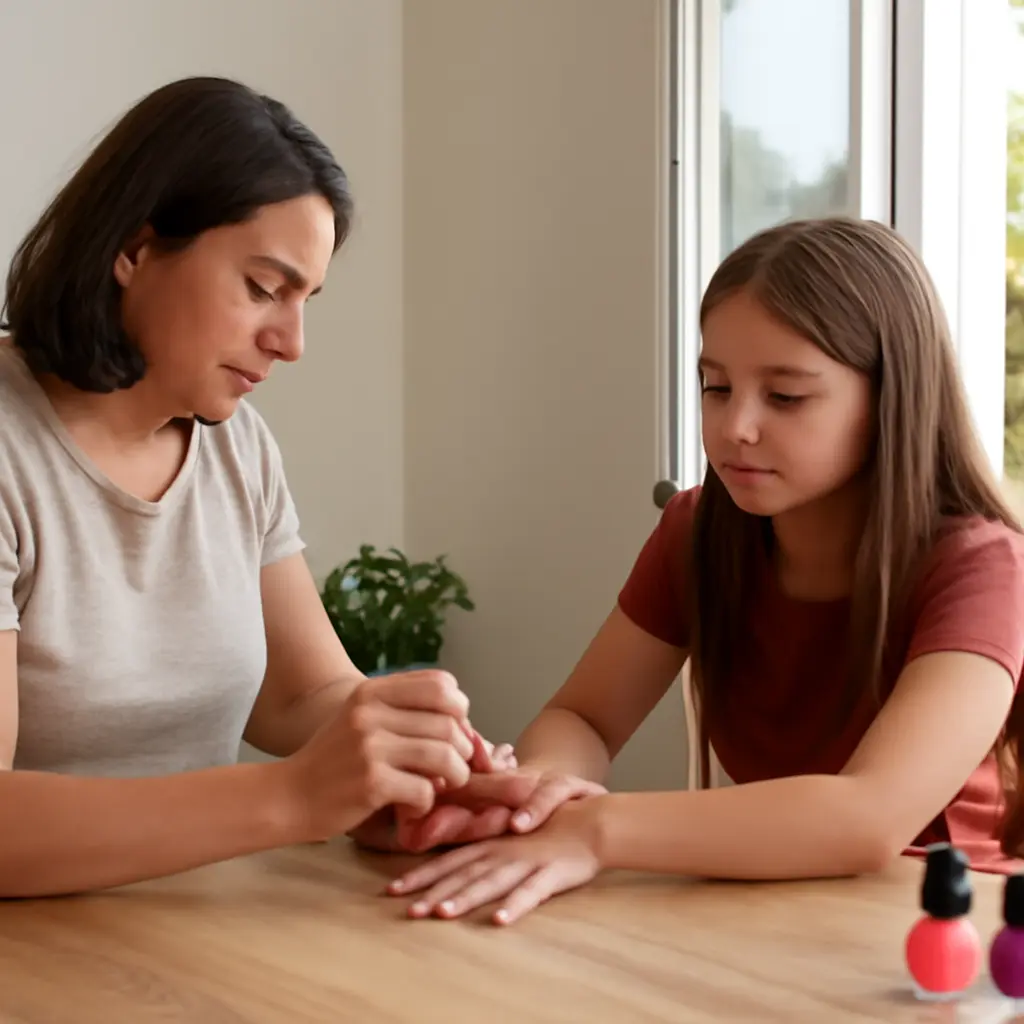
Parents often ask whether nail polish is “safe” for children, but that broad question can obscure the more useful ones: What product is being used, how is it applied, and how likely is a child to swallow it or get it on irritated skin? Nail polish is a mixture of film-forming polymers, solvents, pigments, and other ingredients; ordinary, occasional use on intact nails is different from ingestion, prolonged exposure to fumes, or repeated skin contact. Poison Control reports that small accidental tastes of nail polish commonly cause mild irritation, while larger ingestions can be more serious. Understanding exposure—not relying on labels such as “natural” or “3-free”—helps parents make proportionate choices about conventional polish, children’s products, ventilation, and safer handling.
Nail polish exposure is the key safety attribute parents should assess
Nail polish safety is best understood as the risk of harm from a particular product under a particular pattern of use. The U.S. Food and Drug Administration (FDA) explains that cosmetic safety depends on ingredients and how a product is used; in the United States, cosmetics generally are not preapproved by FDA before sale, although color additives must meet applicable requirements. That makes reading directions, preventing ingestion, and limiting unnecessary exposure more practical than treating every polish as equally hazardous.
Relevant exposure routes include swallowing liquid polish, breathing concentrated solvent vapors, and getting polish or remover on skin or in eyes. Risk varies with the amount, duration, ventilation, age and behavior of the child, and the product’s formulation. A young child who mouths fingers may face a different risk from an older child receiving a brief manicure in a ventilated room.
Ingestion: the most urgent question for young children
Ingestion means swallowing polish or remover, whether by drinking from a bottle, licking wet nails, or sucking fingers. Poison Control notes that a small taste of nail polish is generally expected to cause mild mouth or stomach irritation; swallowing a larger amount can cause more serious effects, including vomiting or central nervous system symptoms, depending on the product and quantity. Nail polish remover is a separate product and may contain acetone or other solvents, so it should not be treated as interchangeable with polish.
If a child swallows polish or remover, remove any remaining product from the mouth and contact Poison Control in the United States at 1-800-222-1222 for product-specific guidance. Do not induce vomiting unless a poison specialist or clinician tells you to. Seek emergency care for breathing difficulty, severe sleepiness, seizures, or other serious symptoms. Keep the bottle available so responders can identify the product.
Fumes: brief use differs from concentrated or repeated exposure
Fume exposure occurs when volatile ingredients evaporate into indoor air. Solvents such as ethyl acetate, butyl acetate, and, in some formulas, toluene contribute to the characteristic odor. A strong smell is not a reliable measurement of dose or toxicity, but it is a useful reason to improve ventilation and move a child away from the application area. The National Institute for Occupational Safety and Health (NIOSH) has documented respiratory, skin, and other hazards associated with workplace exposure to nail salon chemicals; those occupational conditions can involve repeated, extended exposure and should not be equated directly with a brief home manicure.
Use polish in a well-ventilated room, close the bottle promptly, and avoid applying it near a child’s face or in a small enclosed space. Stop if a child develops headache, nausea, coughing, dizziness, or eye irritation, and get fresh air. These steps reduce avoidable exposure without implying that every odor indicates poisoning.
Skin and nail contact: irritation and allergy matter too
Contact exposure occurs when wet polish, remover, or nail products touch skin. Some ingredients can irritate skin, and certain acrylates used in artificial nail systems can cause allergic contact dermatitis. The American Academy of Dermatology warns that nail products can trigger reactions, including itchy, swollen skin around the nails and sometimes symptoms on the face or eyelids after transfer by the hands. This is especially relevant to gel and artificial nail products, which are not the same as ordinary air-drying polish.
Apply polish only to the nail plate, avoid cuticles and broken skin, and stop using a product if a rash, swelling, or persistent irritation appears. A suspected allergy merits advice from a clinician or dermatologist; repeatedly testing the product on the skin is not a safe way to confirm the cause.
Polish ingredients and labels describe formulation, not a guarantee of safety
A formulation is the combination of ingredients used to create a polish’s color, adhesion, flexibility, and drying behavior. FDA notes that cosmetic ingredient labeling is intended to identify ingredients, but marketing language is not a substitute for assessing exposure or checking the product’s directions. Ingredient lists and claims can help compare products, yet neither “non-toxic” nor a numbered “free-from” label should be read as proof that a product is harmless in every circumstance.
“3-free” and similar claims have limits
“3-free” commonly means a polish is marketed without three ingredients historically associated with some formulations—often toluene, formaldehyde, and dibutyl phthalate (DBP). The exact list varies by brand and claim, and expanded labels such as “5-free” or “10-free” are not a single government-standardized safety scale. The FDA has discussed concerns about certain cosmetic ingredients, including formaldehyde and phthalates, but the presence or absence of a named ingredient alone does not establish the overall risk of a finished product.
Parents can use such claims as a prompt to inspect the ingredient list, not as a ranking that automatically makes one bottle safe for toddlers. Application habits, access to the bottle, and the possibility of allergy or ingestion remain important.
“Water-based” and children’s polish still require supervision
Water-based polish uses water as a major carrier or solvent, but the label does not mean that the product is edible or risk-free. It may still contain pigments, film-formers, preservatives, or other ingredients that can irritate or cause harm if swallowed. Products marketed to children should be used according to their directions, kept out of reach, and removed or handled as instructed by the manufacturer.
A child-focused package may be easier to use or formulated differently, but parents should not assume that “kid-safe,” “natural,” or “non-toxic” eliminates the need for adult supervision. Check the actual label and keep all cosmetics—including removers—away from children when not in use.
Safer nail-polish use depends on age, setting, and product type
The practical question is not simply whether a child can ever wear polish, but whether the application setting and the child’s behavior make exposure manageable. The American Academy of Pediatrics’ general poisoning-prevention guidance emphasizes keeping household products in their original containers and out of children’s reach. These basic controls are particularly relevant to polish and remover because both are liquids that can be spilled or swallowed.
For babies and toddlers, prevent access and hand-to-mouth exposure
Babies and toddlers explore by touching and mouthing objects, so wet polish and open bottles create a preventable exposure opportunity. Consider postponing polish if a child is likely to suck fingers or pick at wet nails. If using it, an adult should apply it, keep the child away from the bottle and remover, allow nails to dry fully, and store products immediately in a secured location.
For older children, use supervision and ventilation
Older children may be able to follow instructions, but supervision remains important because spills, eye contact, and accidental swallowing can happen at any age. Use a small amount, keep products off skin, avoid eating or drinking during application, and work where fresh air circulates. Do not let children apply polish in bedrooms, cars, or other poorly ventilated spaces.
Gel, artificial nails, and removers need separate consideration
Gel polish and artificial nail systems involve materials and application processes that differ from conventional polish, including acrylate ingredients and curing under a lamp. Dermatology guidance highlights allergy risks from uncured product contacting skin. Nail polish remover can also present a distinct ingestion and irritation hazard. For children, the simplest precaution is to avoid unnecessary gel or artificial nail applications and to keep remover securely stored and used only by an adult.
A practical parent checklist focuses on exposure, not fear
The following steps translate the evidence into everyday decisions:
- Read the product label and follow its age, use, and removal instructions.
- Apply polish in a ventilated space and close the container immediately.
- Keep polish, remover, and cotton pads out of reach and in their original containers.
- Prevent wet product from touching skin, eyes, or the mouth; do not let a child handle the bottle.
- Stop use if irritation or allergy symptoms develop, and consult a healthcare professional when needed.
- For a suspected ingestion in the United States, call Poison Control at 1-800-222-1222; call emergency services for severe symptoms.
A simple visual summary could compare exposure routes—ingestion, inhalation, and skin contact—with their main prevention steps. The key distinction is that a brief, supervised manicure in a ventilated room is not equivalent to swallowing product or repeatedly breathing concentrated vapors.
Conclusion: ask how exposure happens, not only whether polish is safe
Nail polish safety depends on the product, the route and amount of exposure, and the child’s age and behavior. Ingestion calls for prompt, product-specific poison guidance; fumes call for ventilation and distance; skin contact calls for care around irritation and allergy. Ingredient claims such as “3-free” or “water-based” can inform a decision, but they are not guarantees. Parents can reduce risk by supervising application, preventing access to polish and remover, and seeking professional guidance when exposure or symptoms occur.
For further guidance, consult FDA cosmetic-safety information, Poison Control, and a pediatrician or dermatologist for concerns specific to a child. If an ingestion occurs in the United States, contact Poison Control rather than relying on a label or online guesswork.
Sources: U.S. Food and Drug Administration, Cosmetics: Safety Questions and Answers, https://www.fda.gov/cosmetics/resources-consumers-cosmetics/cosmetics-safety-qa; Poison Control, Nail Polish: Is It Poisonous?, https://www.poison.org/articles/nail-polish; National Institute for Occupational Safety and Health, Nail Salon Workers: Health and Safety, https://www.cdc.gov/niosh/topics/nailsalon/; American Academy of Dermatology Association, Artificial Nails: Dermatologists’ Tips for Reducing Nail Damage, https://www.aad.org/public/everyday-care/nail-care-secrets/basics/artificial-nails; American Academy of Pediatrics, Household Safety: Preventing Poisoning, https://www.healthychildren.org/English/safety-prevention/all-around/Pages/Poison-Prevention.aspx.