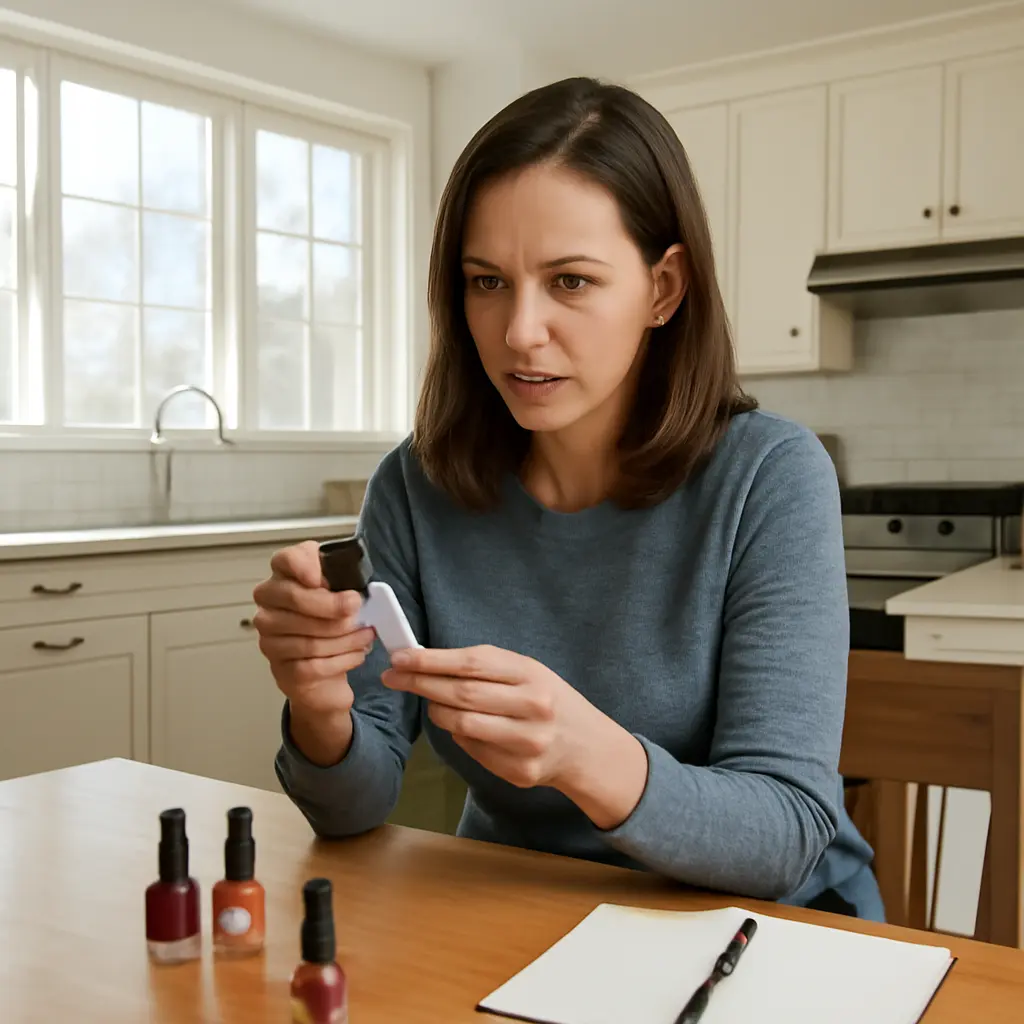
Nail polish ingredient labels list the substances in a formula, but translating their names into practical safety information takes a little context. In the United States, the Food and Drug Administration (FDA) requires cosmetic ingredient declarations on most retail products, generally in descending order by predominance, with exceptions for ingredients at low concentrations and color additives. Learning to read the list helps shoppers distinguish solvents, film-formers, plasticizers, pigments, and other ingredients; understand common “free-from” claims; and recognize when a label cannot answer questions about allergy or exposure. This guide explains the label rules, the roles of major ingredient groups, and sensible ways to check product claims without treating a short ingredient list as a guarantee of safety.
Ingredient labels explain nail polish composition and ordering
An ingredient declaration is the product’s list of ingredients, identified by their established names and arranged according to the applicable labeling rules. FDA regulations require cosmetic ingredient declarations for products sold at retail to consumers, subject to exceptions such as products distributed solely for professional use. Ingredients generally appear in descending order of predominance; ingredients present at 1% or less may be listed in any order after those present above 1%, and color additives may also be listed in any order after the other ingredients.
That ordering provides a useful overview, not a precise recipe. A label usually does not state percentages, and an ingredient’s position cannot by itself establish whether a particular person will react to it. The FDA also notes that cosmetic ingredients do not require premarket approval in the same way that drugs do, although color additives must be approved for their intended uses and cosmetics must be safe when used as directed and properly labeled.
What ingredient order can—and cannot—tell you
The first few ingredients often indicate the main components of a conventional polish. Ingredients below the 1% threshold may appear in a different order, so the final entries should not be read as a reliable ranking of their amounts. A label also does not disclose every detail of manufacturing, impurities, or the concentration of each substance.
As a practical example, a list beginning with a solvent such as ethyl acetate or butyl acetate, followed by nitrocellulose and resins, is consistent with a solvent-based coating. The names alone, however, cannot establish the product’s drying time, durability, or suitability for someone with an allergy.
Professional-use products and other labeling limits
Some cosmetics sold only to beauty professionals may qualify for an exemption from retail ingredient-declaration requirements under FDA rules. If you buy a product in a salon or receive a decanted product without its original packaging, ask to see the manufacturer’s full label or product information. A missing list should not be interpreted as evidence that the formula contains no particular ingredient.
Nail polish ingredients perform distinct formulation functions
A polish formula combines ingredients to create a liquid that can be applied smoothly and then form a colored film as volatile solvents evaporate. The broad functional categories below are useful for interpreting labels, though individual formulas vary. The U.S. National Library of Medicine’s PubChem database describes chemical substances and their properties, while the FDA’s cosmetic guidance explains the regulatory context; neither source can predict a person’s individual sensitivity from an ingredient name alone.
Solvents help polish spread and dry
Solvents keep the formula fluid in the bottle and help it spread across the nail. Ethyl acetate, butyl acetate, and isopropyl alcohol are examples that may appear in nail products. As the solvents evaporate, the remaining ingredients form the coating. Because solvent vapors can be irritating, follow the product directions, keep the cap closed when practical, and use polish in a well-ventilated area.
Film-formers and resins create the coating
Film-formers make the solid layer left on the nail after application. Nitrocellulose is a common film-forming ingredient; resins may help the coating adhere, shine, or resist everyday wear. Their presence describes a formulation role, not a simple safety ranking. The product’s intended use and directions matter, and polish should not be swallowed or applied to skin unless the label specifically directs it.
Plasticizers, pigments, and effect ingredients modify performance
Plasticizers help a dried film flex rather than become overly brittle. Pigments and color additives provide shade or effects, while other ingredients may contribute shimmer, opacity, or stability. FDA approval requirements apply to color additives used in cosmetics, and approval is specific to permitted uses; consumers can consult FDA color-additive information when checking a colorant. An ingredient’s function does not, on its own, indicate whether it is an allergen for a particular user.
“Free-from” claims need context beyond the ingredient list
Marketing phrases such as “3-free” or “10-free” generally refer to a brand’s stated exclusion list, not a universal legal definition or a complete measure of product safety. The FDA advises consumers to read cosmetic labels and warns that terms such as “natural” do not have a general FDA definition for cosmetics. A product that excludes named substances may still contain other ingredients capable of causing irritation or allergy, and an ingredient may be present under a name a shopper does not recognize.
For example, “3-free” often refers to a brand’s decision not to use toluene, formaldehyde, and dibutyl phthalate (DBP), but brands may define the phrase differently. Check the actual ingredient declaration and the company’s explanation rather than assuming that a numbered claim has a standardized meaning. “Free-from” wording also does not replace required labeling or establish that a product is risk-free for every person.
Allergy and exposure concerns call for practical label checks
A contact allergy is an immune reaction following skin exposure to a substance. Nail products can cause problems when they contact skin around the nail or other areas, and reactions may appear away from the fingers. The American Academy of Dermatology recommends avoiding contact between nail products and surrounding skin; if a rash or swelling develops, stop using the product and seek advice from a qualified health professional. Do not try to diagnose an allergy solely from the label or deliberately re-test a suspected trigger.
For people with a known sensitivity, share the complete product label with a dermatologist or allergist. Ingredient names, synonyms, and related chemicals can complicate product selection, so professional guidance may be more useful than relying on a brand’s “hypoallergenic” or “free-from” claim. For general use, follow the directions, avoid inhaling vapors, keep products away from children, and store them as instructed.
A step-by-step method makes label reading more useful
- Find the ingredient declaration on the package or manufacturer’s product information.
- Read the first several entries to identify likely solvents and film-forming components, remembering that ingredient order is not a full concentration breakdown.
- Look up unfamiliar names using a reliable source such as FDA cosmetic guidance or PubChem, and distinguish a chemical’s function from an individual health assessment.
- Check the exact wording behind “free-from,” “natural,” or “hypoallergenic” claims instead of treating them as standardized guarantees.
- If you have a prior reaction or diagnosed allergy, consult a healthcare professional before choosing a substitute.
A simple comparison chart can help organize two products: list each formula’s first ingredients, any personally relevant allergens, the brand’s stated exclusions, and the directions for use. Such a chart can support an informed discussion, but it cannot replace medical advice or establish that one formula is universally safer.
Conclusion: ingredient labels support informed nail polish choices
Nail polish labels identify a formula’s ingredients, while ordering rules offer only a broad view of their relative amounts. Recognizing solvents, film-formers, resins, plasticizers, and colorants makes the list easier to interpret; understanding the limits of “free-from” claims and the possibility of individual sensitivity helps prevent overconfident conclusions. Read the full declaration, follow product directions, ventilate the area, and seek professional guidance if you have a suspected allergy. For further reading, consult FDA cosmetic labeling resources, FDA color-additive information, and a dermatologist or allergist for personal medical concerns.
Sources: U.S. Food and Drug Administration, Cosmetics Labeling Guide, https://www.fda.gov/cosmetics/cosmetics-labeling-regulations/cosmetics-labeling-guide/; Electronic Code of Federal Regulations, 21 CFR § 701.3, Declaration of ingredients, https://www.ecfr.gov/current/title-21/section-701.3; U.S. Food and Drug Administration, Color Additives and Cosmetics, https://www.fda.gov/industry/color-additives/color-additives-and-cosmetics; U.S. Food and Drug Administration, “Natural” and “Organic” Cosmetics, https://www.fda.gov/cosmetics/cosmetics-labeling-claims/natural-and-organic-cosmetics; U.S. National Library of Medicine, PubChem, https://pubchem.ncbi.nlm.nih.gov/; American Academy of Dermatology Association, Nail Care Products Can Cause Allergic Reactions, https://www.aad.org/public/everyday-care/nail-care-secrets/basics/nail-care-products-cause-allergic-reactions