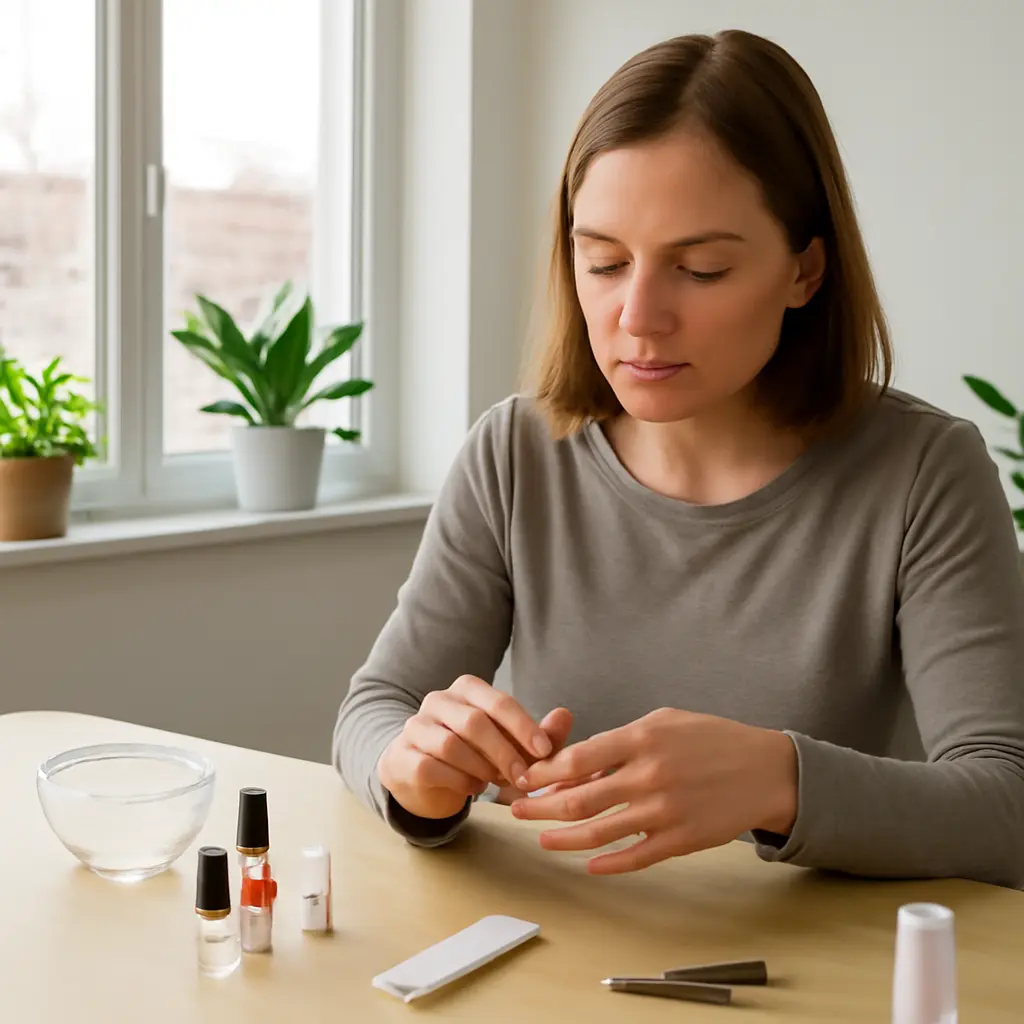
Peel-off nail polish is a type of coating designed to be lifted from the nail rather than dissolved with conventional remover. Its convenience can make it a practical alternative to repeated solvent use, but “dermatologist-approved” should not be taken to mean that every peel-off formula is safer or suitable for everyone: dermatologists’ core advice is to avoid picking or forcibly scraping polish and to limit irritants and allergens. This guide explains how peel-off polish works, what its potential benefits and drawbacks are, how to use it with less risk, and when to seek medical advice.
How Peel-Off Polish Works: The Formula and Removal Attribute
Peel-off polish is a film-forming nail coating that can be removed by gently lifting an edge and separating the dried film from the nail plate. Cosmetic chemists commonly describe these coatings by their film-forming polymers: as the liquid dries, the polymer forms a continuous layer that can flex and release as a sheet. The exact ingredients vary, so the name “peel-off” describes a removal format, not a standardized dermatological certification.
That distinction matters. The American Academy of Dermatology (AAD) warns that frequent use of nail products and rough removal can contribute to nail damage, while the U.S. Food and Drug Administration (FDA) notes that cosmetic ingredients can cause allergic reactions in some users. A peelable finish may reduce reliance on acetone or other removers for that particular manicure, but it does not eliminate exposure to cosmetic ingredients or the risk of mechanical damage.
Film-forming polish versus conventional lacquer
Conventional nail lacquer typically dries into a durable film intended to stay in place until removed with solvent. Peel-off products are formulated to release more readily, often by forming a flexible film that can be lifted at the edges. They may be sold as standalone color, a water-based polish, or a peel-off base coat used beneath another polish. These categories are related, but their wear time and removal behavior depend on the specific formula and how it is applied.
Why removal method matters to nail health
The nail plate is made mostly of keratin and is not living tissue, but the surrounding nail folds and the nail-producing matrix are living structures. Pulling polish off forcefully can take superficial nail layers with it, leaving the plate rough, thin, or flaky. The AAD advises against scraping and picking off polish because those actions can injure nails. The practical benefit of peel-off polish therefore depends on gentle removal—not merely on the product’s label.
Potential Benefits of Peel-Off Polish: Convenience and Lower Solvent Dependence
Peel-off polish can be useful for people who want short-wear color, frequent shade changes, or a manicure that does not require routine solvent removal. It may be especially convenient for occasional use, such as a weekend event or temporary nail art. The potential advantage is narrower exposure to remover during that manicure, not proof that the polish is inherently harmless or medically endorsed.
A practical option for short-term manicures
Because peel-off coatings are designed to lift, they can suit people who prefer to change their color often or avoid keeping polish on for extended periods. Wear varies with the formula, nail preparation, handwashing, and daily activity; there is no reliable wear-time figure that applies to every product. Follow the manufacturer’s directions and treat claims such as “easy removal” as a description of intended use rather than a guarantee of damage-free removal.
Less routine use of nail-polish remover
Acetone is an effective solvent used in many nail-polish removers, but it can dry or irritate skin, particularly with repeated or prolonged contact. The AAD recommends using nail products carefully and moisturizing nails and surrounding skin. A peel-off manicure may reduce how often a person uses remover, although it is not necessarily solvent-free throughout application: some products contain volatile ingredients, and their labels should be checked.
Risks and Limitations: Irritation, Allergy, and Nail-Plate Injury
Peel-off polish is not automatically safer for sensitive skin or damaged nails. Like other cosmetics, it can contain ingredients that irritate skin or trigger allergic contact dermatitis. The FDA explains that cosmetic products and their ingredients can cause allergic reactions, and nail-product reactions may affect skin around the nails or other areas touched by the hands. A published review in Dermatitis has documented allergic contact dermatitis associated with nail cosmetics, including acrylate and methacrylate compounds used in some nail systems; the exact risk depends on the product and exposure.
Allergic contact dermatitis and ingredient sensitivity
Allergic contact dermatitis is an immune reaction that can cause itchy, red, swollen, or blistering skin after contact with an allergen. Reactions may appear on fingertips, around the nails, or on the face and eyelids if product is transferred by touch. Avoid applying polish to skin, use products only as directed, and stop using a product if a rash develops. Anyone with a prior reaction to nail cosmetics should consult a dermatologist before trying another formula rather than relying on a small “patch test” at home.
Peeling, splitting, and weakened nails
A coating can adhere more strongly in some areas than others, especially when nails are dry, rough, or uneven. Pulling the film quickly or repeatedly can lift layers from the nail plate. Do not use tools to pry it off, and do not continue peeling if it resists. If nails become persistently painful, discolored, unusually thick, or detached from the nail bed, pause cosmetic use and seek medical advice; such changes can have causes other than polish.
Safer Use: Application, Removal, and Nail Care
Good technique helps preserve the convenience of peel-off polish without treating removability as permission to pull. Read the ingredient list and directions, apply the product in a ventilated space, keep it off surrounding skin, and allow it to dry fully. If a product is intended as a base coat, use it only in that role; layering incompatible formulas may affect adhesion and removal.
Gentle removal steps
- Wait until the polish is fully dry and identify a loose edge.
- Lift gently with a fingertip; do not dig under the coating with a metal tool or bite it off.
- If the film does not release easily, stop rather than pulling against resistance. Follow the product directions or use an appropriate remover if the label permits it.
- Wash and moisturize hands afterward, and give nails a break if they feel tender or look damaged.
When to pause polish and consult a dermatologist
Stop using the product if you develop persistent itching, redness, swelling, blisters, or nail separation. A dermatologist can assess whether symptoms suggest irritation, allergy, infection, or another nail condition and may recommend formal allergy testing when appropriate. People with existing nail disease, very fragile nails, or a known allergy to cosmetic ingredients should seek individualized advice before experimenting with a new polish.
Conclusion: Peel-Off Polish Is Convenient When Removal Stays Gentle
Peel-off polish is a film-forming coating valued for quick changes and the possibility of using nail-polish remover less often. Its benefits are practical, not a blanket dermatological endorsement: ingredients can still irritate or cause allergy, and forceful peeling can damage the nail plate. Choose products carefully, follow directions, remove polish without prying, and stop if symptoms appear. For persistent reactions or nail changes, consult a dermatologist rather than covering the problem with another manicure.
Sources: American Academy of Dermatology Association, How to care for your nails, https://www.aad.org/public/everyday-care/nail-care-secrets/basics/healthy-nail-tips; U.S. Food and Drug Administration, Allergies to Cosmetics, https://www.fda.gov/cosmetics/cosmetic-products/allergies-cosmetics; U.S. Food and Drug Administration, Nail Care Products, https://www.fda.gov/cosmetics/cosmetic-products/nail-care-products; Raposo, I. et al., Allergic contact dermatitis caused by nail cosmetics: a review, Dermatitis, 2017, https://pubmed.ncbi.nlm.nih.gov/28338598/.