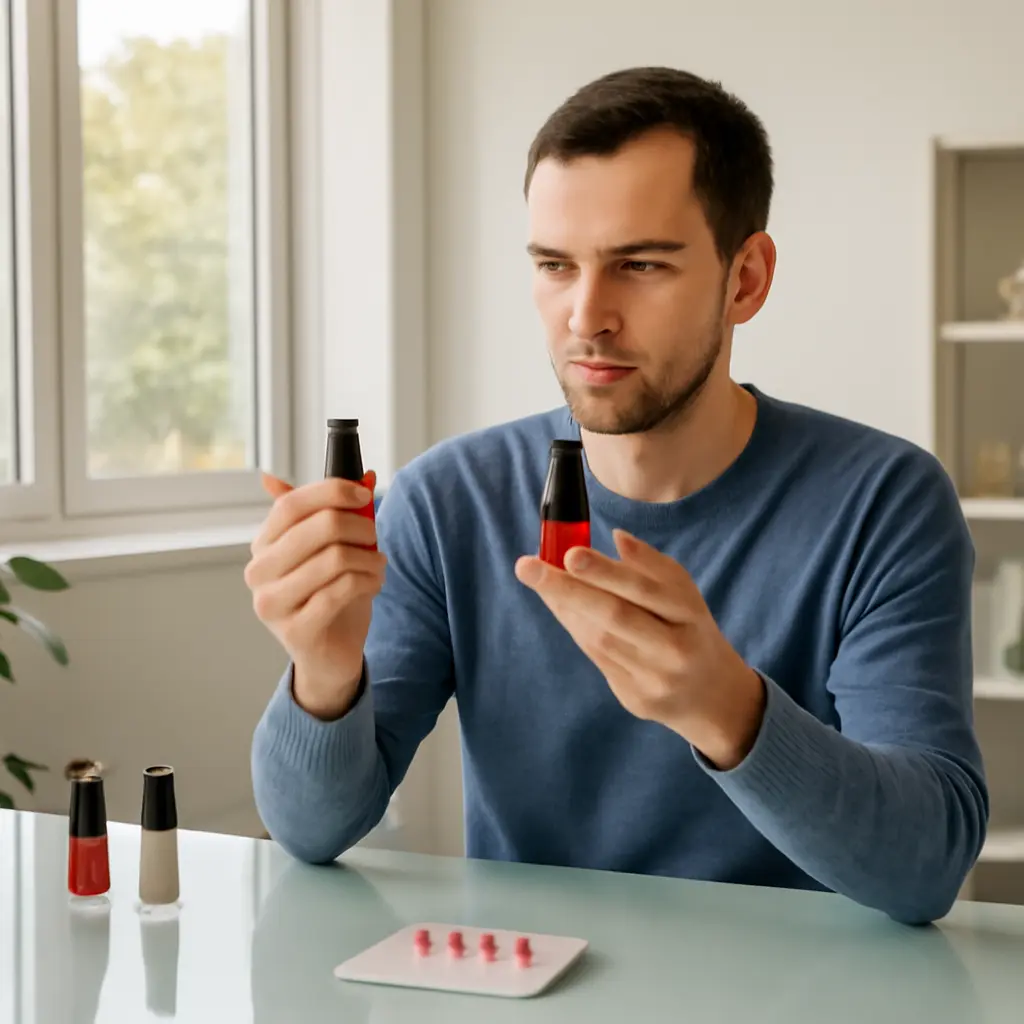
Clean nail polish is a category of nail color formulated and marketed to avoid selected ingredients or reduce certain chemical exposures; it is not a standardized safety grade. Conventional polish often lasts longer or dries more predictably, while clean formulas have narrowed the performance gap: many now offer comparable color and wear, though results vary by product and application. The practical differences come down to formula chemistry, durability, drying, and what “clean” actually promises—not a simple safe-versus-toxic divide. The U.S. Food and Drug Administration (FDA) regulates nail products as cosmetics and notes that ingredients must be safe when used as directed, but the term “clean” has no single federal definition.
Performance reflects the conventional-versus-clean nail polish formula
Conventional nail polish is typically a solvent-based coating made from film-forming polymers, plasticizers, pigments, and volatile solvents. Clean polish generally uses a similar coating approach but may exclude or replace selected ingredients, often advertised through labels such as “3-free,” “10-free,” or “plant-based.” The number usually refers to a brand’s list of excluded ingredients; it is not a regulatory score and does not measure overall safety or performance.
As cosmetic chemist Perry Romanowski explains in his educational materials on nail-polish formulation, polish needs to spread evenly, form a coherent film, and resist chipping; the balance of solvent, resin, film former, and plasticizer affects those properties. Because brands use different ingredient systems and test methods, there is no reliable industry-wide statistic showing that clean polish lasts a fixed number of days less—or exactly as long—as conventional polish. Product-specific wear tests and user experience are more useful than the “free-from” count.
Wear time and chip resistance
Wear time is how long color stays acceptably intact before visible chipping, peeling, or tip wear. Conventional formulas may have an edge in some comparisons because established film-forming and adhesion systems are optimized for durability. But “clean” is not one formula: some clean polishes wear well for several days, while others chip quickly, just as conventional products vary. Nail condition, coats, base coat, top coat, handwashing, and household work can matter as much as the ingredient label.
For a fair home comparison, apply each polish to the same nails or comparable artificial tips, use the same base and top coats, and record chips at the same time each day. This is more meaningful than comparing brands’ advertised wear claims, which may use different testing conditions.
Drying, application, and finish
Drying describes the time required for solvents to evaporate and the coating to become resistant to smudging; it does not necessarily mean the polish has fully hardened. Solvent balance and coat thickness influence drying, so a clean formula is not inherently slower or faster. Thin coats, adequate drying between layers, and avoiding polish on the surrounding skin generally improve the result.
Opacity, smoothness, brush control, and shine also depend on pigment dispersion and the product’s resin and film system. A conventional polish may provide stronger coverage in one shade, while a clean alternative may perform better in another. A glossy top coat can improve shine and help protect either type, but it does not make the underlying formula equivalent to gel or long-wear systems.
Removal and nail condition
Removal depends on the coating’s resistance and the remover used, rather than the clean label alone. Many standard polishes are removed with acetone or non-acetone solvents. The American Academy of Dermatology advises limiting acetone exposure because it can dry and irritate skin and nails; frequent polish removal and aggressive scraping can also contribute to brittleness or surface damage. Follow product directions, avoid peeling polish off, and let nails recover if they become fragile.
Ingredient exclusions define clean nail polish claims
“Clean beauty” is a marketing term, not a legally standardized category in the United States. The FDA says cosmetic products and ingredients generally do not require premarket approval, with color additives as an important exception, and companies are responsible for ensuring product safety. FDA guidance also makes clear that “natural” or “organic” does not automatically mean safe. Therefore, an exclusion claim is best understood as a description of a specific formula choice—not proof that a polish is harmless or safer for every person.
“Free-from” labels and what they mean
“3-free,” “5-free,” and higher-count labels identify ingredients a brand says it has left out, but there is no universal list that every brand follows. One “10-free” list may differ from another, and a larger number does not necessarily mean a better-performing or lower-risk product. Check the ingredient label and the brand’s definition of its claim, particularly if you are avoiding a known allergen or following medical advice.
Commonly discussed ingredients
Ingredients often named in “free-from” claims include toluene, formaldehyde, dibutyl phthalate (DBP), and certain formaldehyde-releasing resins. Their effects depend on the substance, dose, route, and exposure conditions. For example, formaldehyde is recognized by the National Cancer Institute as a human carcinogen, but that classification does not by itself quantify the risk from a particular nail product used as directed. FDA’s cosmetics guidance also notes that ingredients can have different functions and that safety assessments depend on intended use and exposure.
Ingredient lists can be confusing: “formaldehyde resin” is not the same name as formaldehyde, and names that sound similar do not establish identical hazard or exposure. Anyone with a history of contact allergy should discuss suspected ingredients with a dermatologist rather than relying only on a marketing label.
Exposure, ventilation, and allergy
Nail polish can release solvent vapors during application, and skin contact may cause irritation or allergic reactions in susceptible users. The National Institute for Occupational Safety and Health (NIOSH) identifies ventilation and good work practices as important controls in nail salons, where workers may experience repeated exposure to multiple products. For occasional home use, apply polish in a ventilated space, close bottles promptly, and avoid breathing fumes or getting product on skin. Choosing a clean formula does not remove the need for these precautions.
Choosing between conventional and clean polish depends on priorities
The best choice depends on the user’s performance expectations, ingredient sensitivities, and application habits. A clean polish may suit someone who prefers a product with certain ingredients excluded; a conventional formula may be preferable if a particular shade, finish, or wear performance works better. Neither category guarantees a specific level of safety, and neither replaces careful use.
A practical comparison checklist
- Compare the full ingredient list and the brand’s exact definition of “free-from.”
- Look for wear, drying, opacity, and removal information for the specific shade and product.
- Use thin coats and a compatible base and top coat; follow the manufacturer’s directions.
- Apply in a well-ventilated area and prevent prolonged skin contact.
- Stop using a product if it causes itching, swelling, redness, or other irritation; seek medical advice if symptoms persist.
A realistic at-home performance test
To assess the real performance gap, compare one conventional and one clean polish with similar shades and finishes. Keep nail preparation, coat count, base coat, top coat, and drying intervals the same. Record time to first chip, overall appearance, and ease of removal over several days. This small test will not prove broad product superiority, but it can identify which specific formula performs best for your nails and routine.
A chart could track “days to first chip” and “removal effort” for each product, with notes on application and daily activities. Such a comparison is more informative than treating a “10-free” claim as a performance rating.
Conclusion: the performance gap is product-specific
Conventional and clean nail polishes share the same basic goal: a colored film that applies smoothly and lasts. Conventional formulas may outperform some alternatives in wear or application, but clean options have become more varied, and the label alone cannot predict results. “Free-from” counts are not standardized safety ratings, while ventilation, careful application, and avoiding known allergens matter with either category. Compare ingredient lists and test individual products against your priorities; consult a dermatologist about allergy concerns and FDA or NIOSH guidance for broader cosmetic and workplace-safety information.
Sources: U.S. Food and Drug Administration, Cosmetics Q&A: Personal Care Products, https://www.fda.gov/cosmetics/cosmetics-qa-personal-care-products; U.S. Food and Drug Administration, Is It a Cosmetic, a Drug, or Both? (Or Is It Soap?), https://www.fda.gov/cosmetics/cosmetics-laws-regulations/it-cosmetic-drug-or-both-or-it-soap; American Academy of Dermatology Association, Nail care tips, https://www.aad.org/public/everyday-care/nail-care-secrets/basics/nail-care; National Institute for Occupational Safety and Health, Nail Salon Workers: Health and Safety, https://www.cdc.gov/niosh/nail-salon/; National Cancer Institute, Formaldehyde and Cancer Risk, https://www.cancer.gov/about-cancer/causes-prevention/risk/substances/formaldehyde/formaldehyde-fact-sheet; Perry Romanowski, Chemists Corner, Nail Polish Formulation and Cosmetic Science resources, https://chemistscorner.com/